Why Regular Cleaning Isn’t Enough After Renovation
October 18, 2025
Installing Doors, Baseboards, and Casings: Key Details for Perfect Alignment
October 30, 2025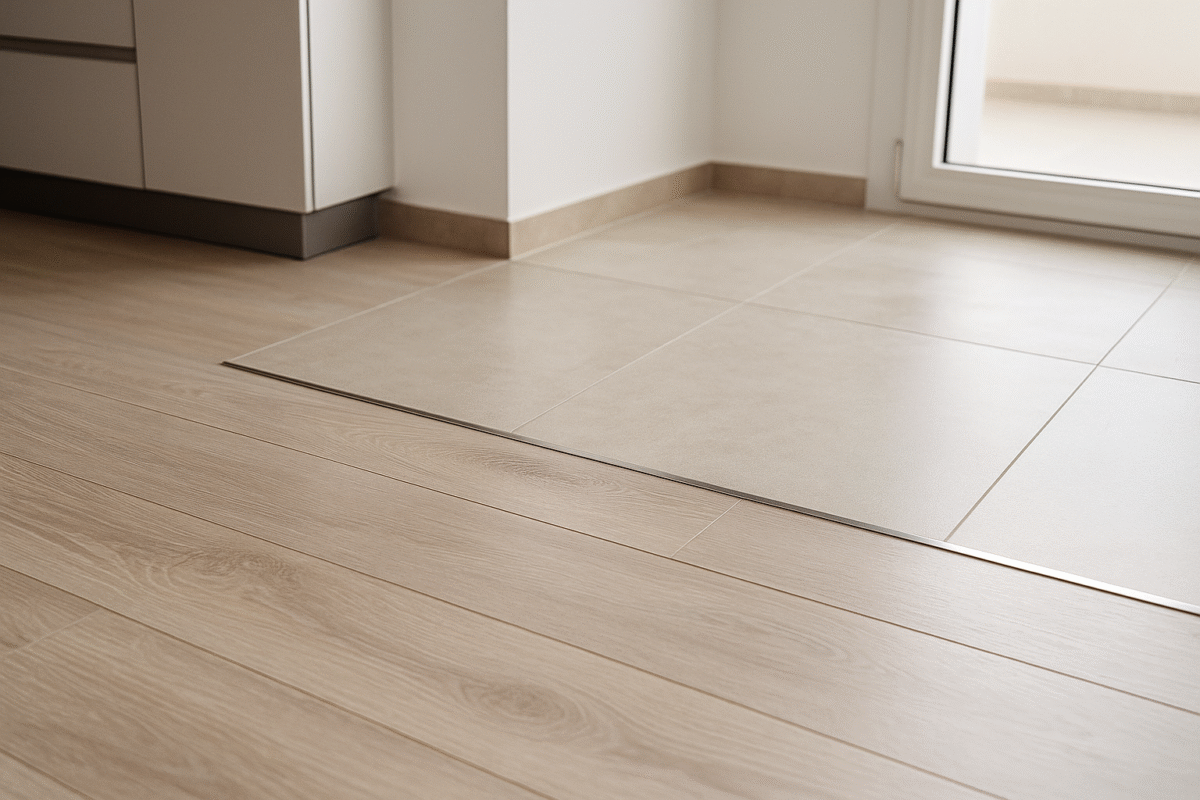
In modern interiors, it’s common to combine different types of flooring — for example, tile in the kitchen and laminate or vinyl in the living room.
The junction between these materials may look simple, but it’s one of the most noticeable and delicate details in the entire floor design.
Ayucorp performs professional floor installation and joint finishing in Alicante, ensuring perfect alignment, smooth transitions, and long-term durability.
Why Proper Transitions Matter
A poorly made joint can:
- Create a visible height difference,
- Cause cracks and chipping at the edge of the tiles,
- Let moisture penetrate, damaging wooden coverings,
- Spoil the overall look of the floor.
A correct installation ensures comfort, safety, and aesthetics.
Step-by-Step: How to Make a Perfect Tile-to-Floor Joint
1. Leveling and Planning
Before installation, the height difference between the two coverings must not exceed 2–3 mm.
Ayucorp experts plan the layers — adhesive, underlayment, and flooring thickness — so the materials meet evenly.
2. Choosing the Right Profile
Profiles (also called thresholds or transition strips) protect the edge of each material and create a clean border.
Main types:
- Aluminum or stainless steel profiles — durable and modern;
- PVC profiles — flexible and suitable for curved joints;
- Flush (hidden) joints — for minimalistic interiors;
- Cork or silicone expansion joints — absorb movement and temperature changes.
3. Proper Cutting and Fitting
Edges of the tile and flooring should be perfectly straight.
Use a tile cutter or jigsaw with fine blade for precise edges.
Leave a small expansion gap (2–5 mm) if working with laminate or vinyl.
4. Fixing the Profile
Profiles can be:
- Mechanical — attached with screws before flooring installation;
- Adhesive — mounted with flexible sealant;
- Insert-type — clicked into a base track for easy replacement.
Ayucorp often uses flush aluminum profiles for seamless and elegant transitions.
5. Sealing the Joint
If no profile is used, fill the joint with elastic sealant or cork insert to protect against moisture and hide small gaps.
Design Tips
- Choose profiles in the same color tone as the flooring.
- For open-plan spaces, align the joint line with architectural elements (columns or walls) to make it look intentional.
- In humid zones (kitchens, bathrooms), always use waterproof materials.
Common Mistakes
Mistake | Consequence |
Uneven subfloor | Visible height difference |
Wrong profile choice | Loose or noisy joint |
No expansion gap | Buckling of laminate |
Unsealed edge | Moisture damage |
Misaligned joint line | Visual imbalance |
Ayucorp’s Professional Standards
- Precision tools for laser-level alignment;
- Use of European-made profiles (Schlüter, Progress Profiles);
- Waterproof sealing and expansion compensation;
- Clean finish guaranteed.
Conclusion
A neat transition between tile and other floor coverings is a subtle detail that reflects overall craftsmanship.
When done correctly, it’s invisible — and that’s the best compliment to any renovation.
In Alicante, Ayucorp ensures smooth, aesthetic, and durable transitions that last for years.